Hypocrisy in Arab societies:
ONE of the biggest tragedies of our times is the spread of a culture of lies and hypocrisy in Arab societies. It is quite unfortunate that hypocrisy has become the norm and a way of life and it is accepted by people without criticism or condemnation.
We have noticed that what has been acceptable and practiced by individuals comfortably in private away from the eyes of people becomes prohibited, rejected and non-acceptable when it is done publicly in broad daylight.
Many people do not have any problem in doing certain things outside the Kingdom’s borders and in foreign tourist spots. At the same time, they oppose such practices inside the country.
As long as you are away from the eyes of people, it becomes your right to practice what has been denied or rejected thus far fearing spiteful public comments and criticisms.
Many of us have different faces and masks which they show, depending on the situations, places and people around them. Here I am not talking about what has been rejected religiously and morally but about certain practices that come within religious and moral limits.
We know that many practices and behaviors are the products of heavy social and cultural pressures. People often ignore the fact that those practices go against moral values and religious teachings. We can find examples for this in changing lifestyles and the needs of new realities.
Let us talk about extravagance in our weddings and other ceremonies, especially the sound pollution caused by music in wedding halls. Despite all these painful realities you will find people leveling accusations and allegations against you if you dare to open a music academy to teach the best of music and develop a desire among people to enjoy it.
Despite all these bitter realities you will not find anyone who denounces extravagance in our functions and ceremonies, although it goes against the teachings of Islam. At the same time people will denounce superficial things that do not cause any harm to the public and this is clear hypocrisy.
We have seen a culture of shame spreading in our society. It enforces various constraints and creates unnecessary social and mental burden as well as social and mental conflicts.
This culture of shame also hits us economically and materially as people spend lots of money on enhancing their appearance. This is again a sign of hypocrisy, which has unfortunately become the hallmark of our Arab culture. Many of us are used to this culture and as a result we don’t talk against it, considering it as part of our life.
This hypocrisy goes against the teachings of our religion, which calls for honesty and simplicity in life. It urges us to rid ourselves of hypocrisy, arrogance, overindulgence and all other base behaviors that push people to the gutters of failure and defeat.
The most dangerous consequence of this culture of shame is that it produces individuals having dual personalities who will not be mentally upright. They suffer from painstaking mental conflicts. They will fear people and their comments more than their Creator, the Almighty Allah. Such people will lose their integrity and moral values, which will be broken into pieces.
If you go against what is customary you will certainly face lots of criticism. You will be accused of showing religious hatred even if you uphold the truth providing convincing evidence.
The continuation of hypocrisy, on the other hand, would create an atmosphere where all the lies and falsification become readily acceptable to the same people. When accustomed to the lies, people would have no qualms in accepting any sort of ideology.
Kurdistan: The Impending Pillar of Hope in a Turbulent Middle East
It is known to the world that the Kurdistan Region in Iraq is facing daunting problems, as it combats the currently largest global terrorist threat, the self-proclaimed Islamic State, or ISIS. The courage of the Peshmerga, the Kurdistan army that halted ISIS’ advancement two years ago, and which keeps counting victories over this vicious terrorist group, has entered world history. Add to that the fact that these brave men and women are fighting with old weapons, unlike ISIS fighters, who confiscated modern and heavy weaponry from the Iraqi army that the U.S. provided.
Fearing the threat of ISIS and political instability, investors and foreign companies left Kurdistan, which had a sizeable impact on the region’s economic development. In addition, since February 2014, the Iraqi central government stopped paying its financial obligations to Kurdistan, all while more than two million refugees and internally displaced people of all ethnicities and nationalities found refuge in the Kurdistan region, fleeing ISIS.
To address these challenges, the government in Erbil has launched a set of reforms to create a more efficient administration and to diversify the economy, which is still heavily dependent on oil and gas exports. The liberation of Mosul is expected to send between 500,000 and 1,000,000 additional refugees to the Kurdistan region, and will undoubtedly have abysmal effects on its fragile economy. The international community will need to commit to longer-term aid and financial assistance, which will be crucial to defeating ISIS not only militarily, but also their entire ideology. The fear is that if basic living conditions for refugees are not created and sustained, additional resentment might develop and new terror groups could emerge. The process of finding permanent homes for refugees will be slow at best, as ISIS destroyed numerous villages and placed landmines in others. Those mines are placed within building walls, which make them almost impossible to neutralize, and are planted there with the sole reason of potentially killing more people who try to dismantle them in an effort to inhabit the villages. Just a few days ago, Peshmerga Colonel Peshkaft Zuher Khalid was killed while attempting to dismantle a mine left by ISIS in Tulaband village. He was 34 years old and left three sons and a daughter behind.
To address these challenges, the government in Erbil has launched a set of reforms to create a more efficient administration and to diversify the economy, which is still heavily dependent on oil and gas exports. The liberation of Mosul is expected to send between 500,000 and 1,000,000 additional refugees to the Kurdistan region, and will undoubtedly have abysmal effects on its fragile economy. The international community will need to commit to longer-term aid and financial assistance, which will be crucial to defeating ISIS not only militarily, but also their entire ideology. The fear is that if basic living conditions for refugees are not created and sustained, additional resentment might develop and new terror groups could emerge. The process of finding permanent homes for refugees will be slow at best, as ISIS destroyed numerous villages and placed landmines in others. Those mines are placed within building walls, which make them almost impossible to neutralize, and are planted there with the sole reason of potentially killing more people who try to dismantle them in an effort to inhabit the villages. Just a few days ago, Peshmerga Colonel Peshkaft Zuher Khalid was killed while attempting to dismantle a mine left by ISIS in Tulaband village. He was 34 years old and left three sons and a daughter behind.
After Mosul is liberated, the international community must prepare for long-term humanitarian aid, including funding for basic living conditions such as educational subsidies, medical support, food, and solid sanitary equipment, if to avoid new wave of despair and resentment that can lead to the creation of new terrorist cells or groups
Talks about a post-ISIS future for the Mosul area are already well underway, whereMasoud Barzani, Kurdistan Region President, already supported requests by Yezidis, Christians, Shabaks, Kakais, Armenians, and Assyrians, for independent administration and self-rule of Nineveh province.
The liberation of Mosul will be a huge leap forward for the Kurdistan region. After ISIS is repelled further from its borders, investors are expected to start coming back. Plenty are already eyeing ways to enter or re-enter projects and foreign ministers, ambassadors, and other officials are daily meeting with Kurdistan Region government officials. And rightly so, as opportunities for cooperation are plenty.
 The city of Rawanduz, located some 80 miles from Erbil, with a stunning view and a fresh supply of sweet mineral water (PHOTO: Sarkawt A. Sabir)
Restoring the Agricultural Richness of the Kurdistan Region
Kurdistan, formerly known as the “Breadbasket of Iraq,” has 1.5 million hectares of irrigated lands, and 70 percent of the grain production in Kurdistan Region is organic. In addition, Kurdistan annually produces 1.6 million tons of wheat, of which it domestically only uses 650,000 tons, leaving one million tons available for export. Yet Iraq is not buying wheat from the Kurdistan Region, and is importing it from Iran and Turkey. Furthermore, the region’s fruit production is also substantial. The Barwar Bella region alone (Duhok province) produces more than 28,000 tons of apples, and Halabja produces over 50,000 tons of pomegranates on an annual basis. Opportunities for U.S. businesses are plenty in the agricultural sector, where technology is needed for further growth. Now is the time to start exploring these opportunities through the union of farmers in Kurdistan and become connected to the existing agriculture private sector for exploring joint business opportunities.
The extent to which politics undermine economics in this part of the world is proven by this letter from the Iraqi Ministry of Commerce issued on October 19th 2015, in which instructions were given to not honor the payment for the already-delivered agricultural goods from Kurdistan, Kirkuk, Anbar, Nineveh and Om Qasr but to pay farmers throughout Iraq with allocated 680 billion Iraqi dinars (around 600 million USD).
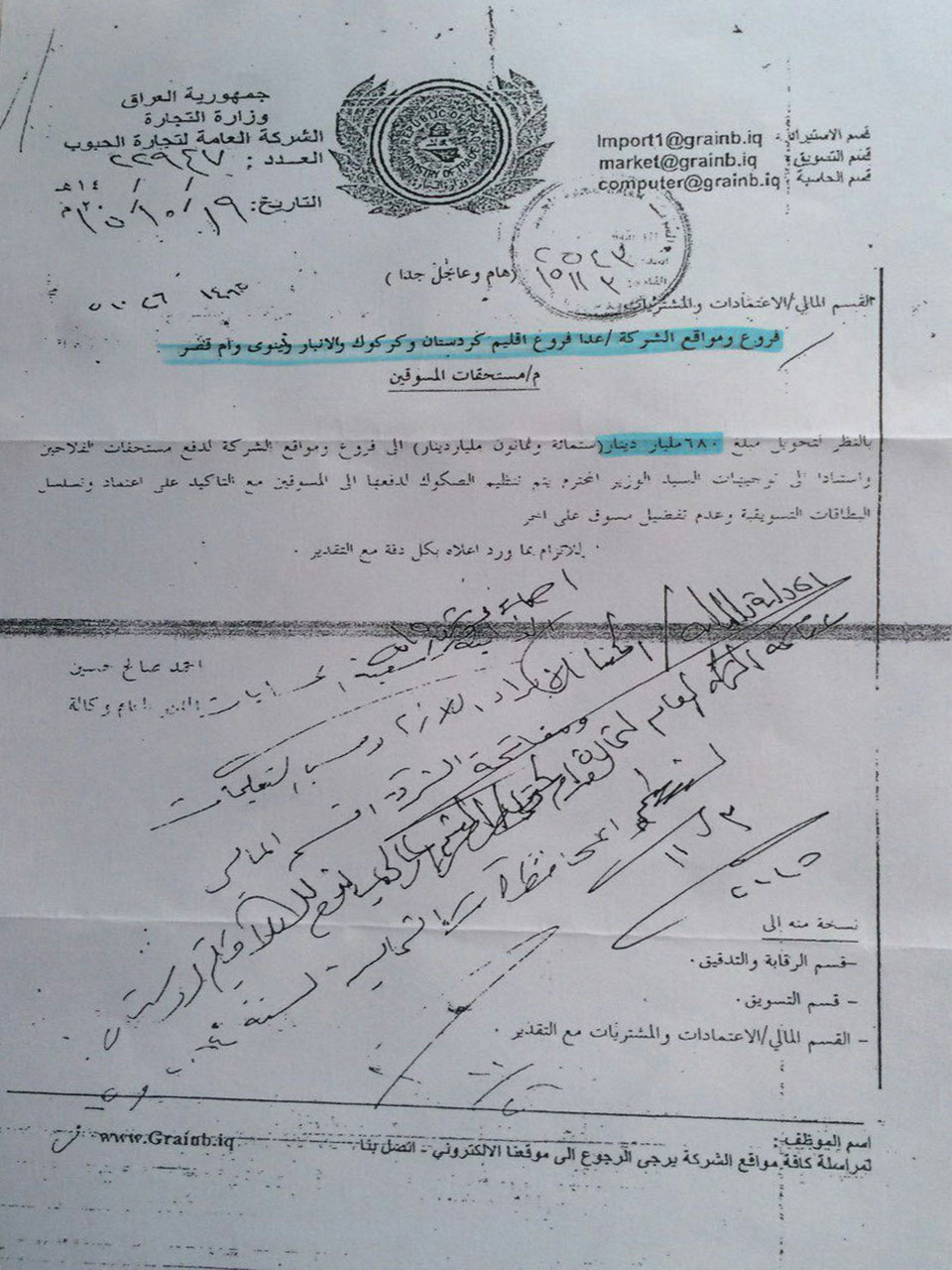 in October 2015, the Iraqi Ministry of Commerce issued a letter instructing the government in Baghdad to pay all Iraqi but not Kurdish farmers for delivered agricultural products to Baghdad in 2014 and 2015.
A lack of property rights is a huge problem for economic development in the Middle East, and so it is in Kurdistan, a condition inherited from Saddam’s times. The KRG should look to reform the agricultural sector to allow for individual ownership of the land, to encourage farmers to use owned land as a collateral in obtaining bank loans to expand their businesses and foster international business cooperation. It is a win-win situation where government will have increases in tax revenue and the agricultural sector will be a strong and stable pillar of private sector business. To boost the revenue, requests should be made to the UN and other international agencies that will be instrumental in post-ISIS Mosul (and other territories’) rebuilding effort, to buy wheat and other products from local farmers in the Kurdistan region, instead of importing ready-made products for their needs from neighboring countries.
Group Tourism Gaining Momentum in the Kurdistan Region
Before ISIS, the Kurdistan region was a very popular tourist destination and would host over three million visitors annually. In 2014, Erbil was named the “Capital of Tourism“ by the Arab World Tourist organization. Understandably, the very present fear of ISIS had significantly decreased visitor numbers, but as of the last two months tourism started to pick up again as security in the Kurdistan Region is improving. Even though ISIS is still a major danger for the region, its threat to security is significantly diminished within the Kurdistan Region.
On July 7th this year, the second day of Eid, 18,000 visitors entered Kurdistan, and nearly 200,000 visited the region in July, mostly from the rest of Iraq. The Kurdistan Regional Government (KRG) is in the process of negotiating agreements with Turkey, Iran, Armenia, Kuwait, and Jordan on group tourism to make it easier to obtain visas for organized group travel through security check points.
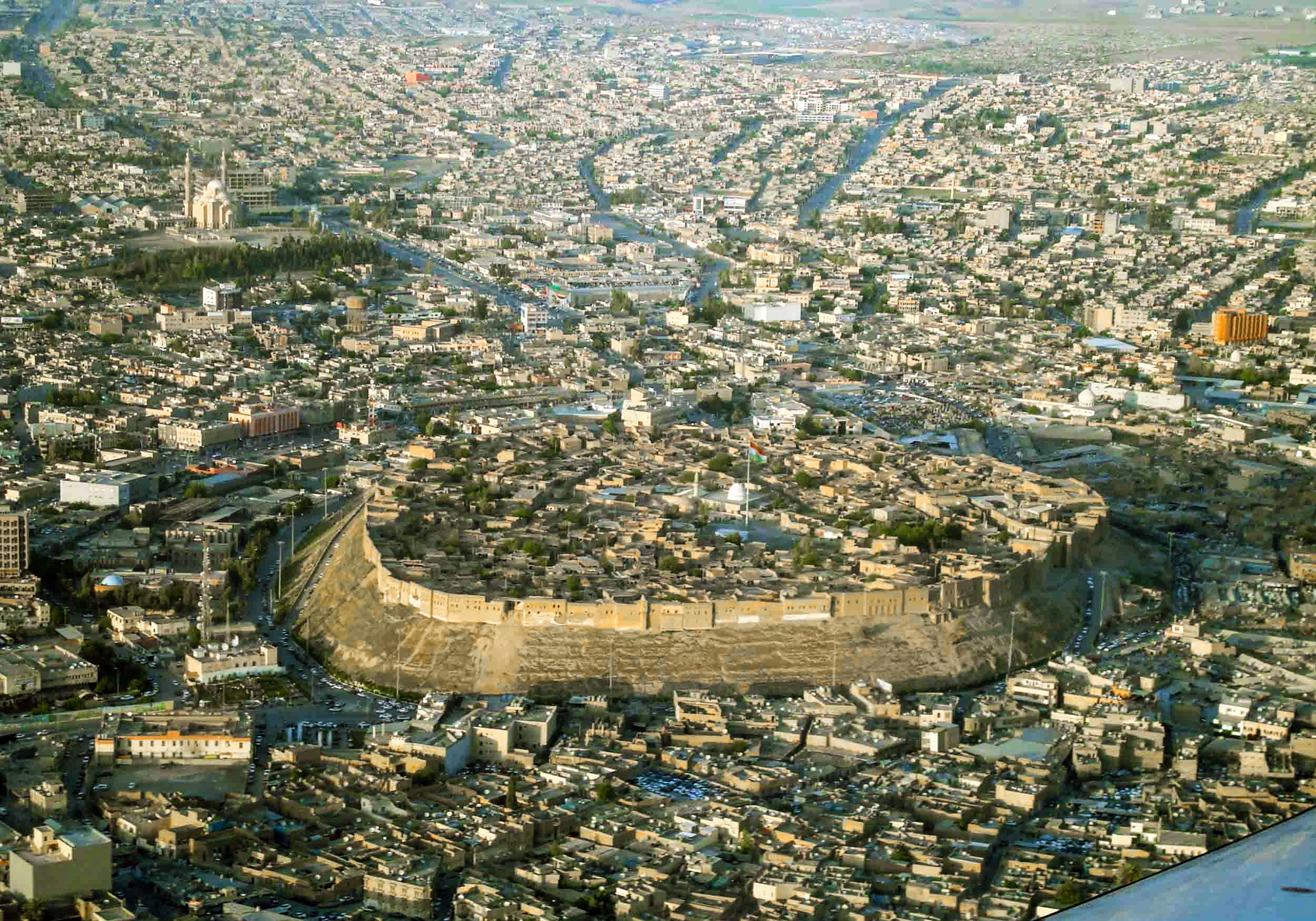 The Citadel, located inside Erbil, is one of the oldest uninterruptedly inhabited towns in the world. It is listed in the UNESCO world heritage list and is currently undergoing restorations (PHOTO: Jan Sefti)
The Kurdistan Tourism Guide, an excellent smartphone app, and the General Board of Tourism website, are available in five languages and are a great tool to discover the hidden beauties, the cultural and historical treasures of the Kurdistan Region.
 At the Gem Stones Museum in the Citadel in Erbil, the owner’s son in fluent English guides visitors to rare stones from Kurdistan, region, and world (PHOTO: Sasha Toperich)
During my recent visit to Erbil, I visited the small but wonderful Institute and Museum of Stones and Gems, which is privately owned by a Kurdish family, located at the heart of the ancient Citadel in Erbil. I made a promise to this young man (in the picture) to not only mention the museum, but to also to spread the word about the Kurdistan’s tourism richness. His determination to create a life in spite of all the imposed difficulties was a very humbling experience. I truly admire the spirit of the people in Kurdistan, tirelessly working to reinvent their lives, and to create a better future. As the government officials in Erbil often say, “we’ve made mistakes, but we are now correcting them.” This tends to be true, and although there is much work to be done and the road ahead is long, the Kurdistan Region is on the right track.
next
India’s main concern is the rise of ISIS and the wellbeing of more than seven million Indians working in the larger West Asia region.
India’s newly appointed Minister of State for External Affairs, MJ Akbar, is preparing for a vital visit to Damascus in Syria, Baghdad in Iraq and Beirut in Lebanon. Of course, perhaps the most important visit of these three troubled capitals of West Asia is Damascus where Akbar will make a courtesy call on President Bashar al-Assad, a man India still holds in high regard thanks to the strong bonds built between the two countries over the past many decades.
The groundwork for Akbar’s trip was laid when he had not even joined his new position. Earlier in January, deputy Prime Minister of Syria, Walid al-Moualem, visited New Delhi and met with Minister for External Affairs Sushma Swaraj and other officials to discuss a host of security, bilateral and economic issues. Moualem had invited Swaraj to visit Syria, perhaps hoping for a larger Indian presence in bringing an end to the country’s crisis.
Syria remains the world’s most violent and dangerous conflict zone at the moment. As a beleaguered Assad regime battles ISIS and various other militant factions which include groups led by Al Qaeda , New Delhi is seemingly happy to offer its long-standing support to it.. Because of unprecedented support shown by Russia, combined with the rise of ISIS and the global outcry to tackle the same, New Delhi seems to have concluded that Assad is in a much more comfortable spot than he was in just a year ago.
India would not want to see Syria go the way of Libya after a poorly executed Western military intervention in 2011. The political vacuum created thereafter turned Libya into a fertile ground for Islamist groups such as Al Qaeda and ISIS to set up significant presence.
Moualem was the highest-ranking official to visit India since Bashar al-Assad’s visit in 2010. During his visit, he asked India to resume its already committed aid for infrastructure projects in the country, such as the Tishreen power project being implemented by Bharat Heavy Electricals Ltd for which India had already released $100 million before the crisis erupted. Even now, New Delhi has said it is ready to resume work if Damascus is ready to guarantee security (which it can’t). Moualem also secured $1 million in medical aid from India. New Delhi has previously provided medical aid to the Syrian government both directly and via the United Nations, according to some officials.
The rising threat of ISIS
For lack of a better word, India’s stance on the Syrian crisis can be termed as sporadic. In 2013, the Ministry of External Affairs in a statement said, “there could be no military solution to this conflict”. However, India has engaged with the Assad regime in a sly yet subtle manner throughout the conflict. During President Pranab Mukherjee’s visit to Jordan, Israel and Palestine last year, India’s then Secretary (East) at the Ministry of External Affairs said that while India supported the Geneva round of talks for a peaceful resolution to the Syrian crisis, its stance on Russian military intervention in Syria was acknowledgement that Moscow was doing so to “halt the advances of the Islamic State (ISIS)”. Thus India has advocated both an anti-military interventionist peaceful dialogue process and a Moscow-led military intervention.
Previously, in 2014, India was also perhaps the only country to send a business delegation into Damascus at a time when violence in the country was at its peak. Syria even then had invited India to participate in its post-war plans to rebuild and had reminded New Delhi that if it waited till the end of the conflict to commit further funds, it stood to lose out on lucrative contracts to others.
During this period of heavy fighting in the country and the ups-and-mostly-downs of the Vienna peace talks, Damascus sent its advisors, in particular political and media advisor to Assad, Dr Bouthaina Shaaban, to New Delhi regularly in order to shore up support not just in India, but also within new representative multilateral groupings such as BRICS, BRICS Bank, Asian Development Bank and the like.
It is highly unlikely that Akbar’s visit to Damascus and meeting with Assad will in any way open any new front between India and Syria, whether political or economic. New Delhi is happy, for now, to see Assad in charge in the Syrian capital as it is well aware that without a concrete succession plan in place, his removal will throw Syria into further chaos, if that is even possible, and unsettle the larger Gulf region with its domino effect. With Iraq already the second largest hot-bed for ISIS, India’s main concern is the lives and well being of more than seven million Indians working in the larger West Asia region who could potentially be at risk.
This visit will also give the Indian government a closer look at the war against ISIS, an issue which has now started to ring alarm bells at home with the recent attacks in Bangladesh and the reported rise of Wilayah Khorsan (also known as ISIS Khorsan) in Afghanistan along with sporadic cases of Indian citizens being radicalised in the name of ISIS. A recent charge sheet filed by the National Investigation Agency in Mumbai named one Shafi Armar aka ‘Yusuf al-Hindi’ as ISIS’s recruiter in India, along with three other people. Whatever may be the reality of the ISIS threat in India, this highlights increased efforts and a sense of urgency within India by agencies to weed out even nascent signs of activities supporting people to join ISIS here or in the Gulf.

No comments:
Post a Comment